
In a commercial kitchen, a gas grill can serve as the true workhorse of your culinary exploits. Whether your gas grill features a flat-top or the traditional flame-broiling setup of a conventional gas grill, few appliances get the daily workout that your commercial gas grill endures. Fortunately, most modern commercial grills are built to last and can provide years of faithful service before you’re forced to find a new commercial gas grill for sale.

However, because of the workload they carry in a professional setting, many commercial grills require routine cleaning and maintenance to work at optimal levels. While the cleaning task can be a chore, it’s necessary to get the most out of your gas grill and keep it running for years to come. Fortunately, keeping your gas grill in top shape requires little more than a few common tools and a little bit of effort. Keep reading to learn a few tips that you can use to keep your commercial gas grill clean and functioning for years to come.
Necessary Supplies
While there are a few tools that will make cleaning your commercial gas grill easier, there really isn’t much specialized equipment required. Start with the basics. You’ll need a cannister, bucket, or tub that will be used to collect grease. You’ll need some kind of abrasive item such as a heavy wire brush, grill block, or a metal scraper. You may also want to use a cleaner of some sort to break up cooked-on grease and sanitize the freshly cleaned surfaces.
When selecting a cleaner, make sure that you use something that won’t do more harm than good. For example, if you have cast iron grill grates that require seasoning, even a natural cleaner like vinegar can strip away your non-stick layer. In most cases, you will need little more than warm, lightly soapy water to get the job done. Finally, it doesn’t hurt to have gloves, and it’s even better if they’re silicone or otherwise heat-resistant.
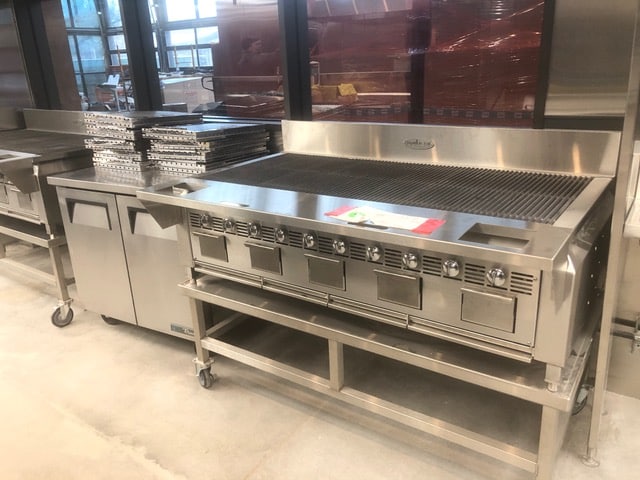
Cleaning Tactics
First of all, never try to clean a hot grill. While a warm grill can be easier to clean due to more viscous grease, cleaning a grill that is above 150 degrees can be painful and dangerous. Let the grill cool before attempting to clean it. Once your grill has reached a comfortable temperature, make sure to start by emptying the grease trap. It’s best to take care of that first so you won’t drip grease on your freshly cleaned surfaces.
Once the trap is clean, use the scraper or abrasive on the grill top surface. Make sure to scrape away as much charred on grease and food as possible. You may need to apply a little soapy water to loosen deposits before scraping. When the majority of deposits are loosened, use a damp cloth to wipe away the debris.
Cleaning your grill is about more than cleaning the cooking surface, however. Therefore, don’t forget about the burner area and internal components of the grill. Clean any area where grease may drip, as it can cause a fire hazard if it accumulates.
Re-Seasoning Your Grill
Once you’ve cleaned the cooking surface and the internal portions of the grill, it’s time to re-season it. Seasoning provides a natural non-stick surface on your cooking area. While most commonly associated with cast iron cooking surfaces, it’s important to re-season any metal cooking surface after cleaning.
Re-seasoning is simple. Apply a light coating of oil to the cooking surface and turn on the grill. Allow it to heat up sufficiently. When the oil on the grates begins to smoke slightly, turn the grill off and let it cool. Repeat the process two or more times to get a good non-stick coating on your cooking surface.
If you purchase a quality commercial gas grill, it can provide you with years of reliable service if properly cleaned and maintained. To learn more about commercial gas grill cleaning and maintenance, visit Champion Tuff Grills.
